
Industrial Sewing Parts · Buying Guide · 6 November 2026
Sewing Machine Needle Plate: Functions, Types and Buying Guide
Understand what a needle plate does, how different designs affect sewing, and how to verify the right replacement for your industrial machine.
Quick answer
A sewing machine needle plate supports fabric around the needle and provides openings for the needle and feed dogs. To replace it safely, match the exact machine model and the part reference in the manufacturer's parts catalogue.
What does a sewing machine needle plate do?
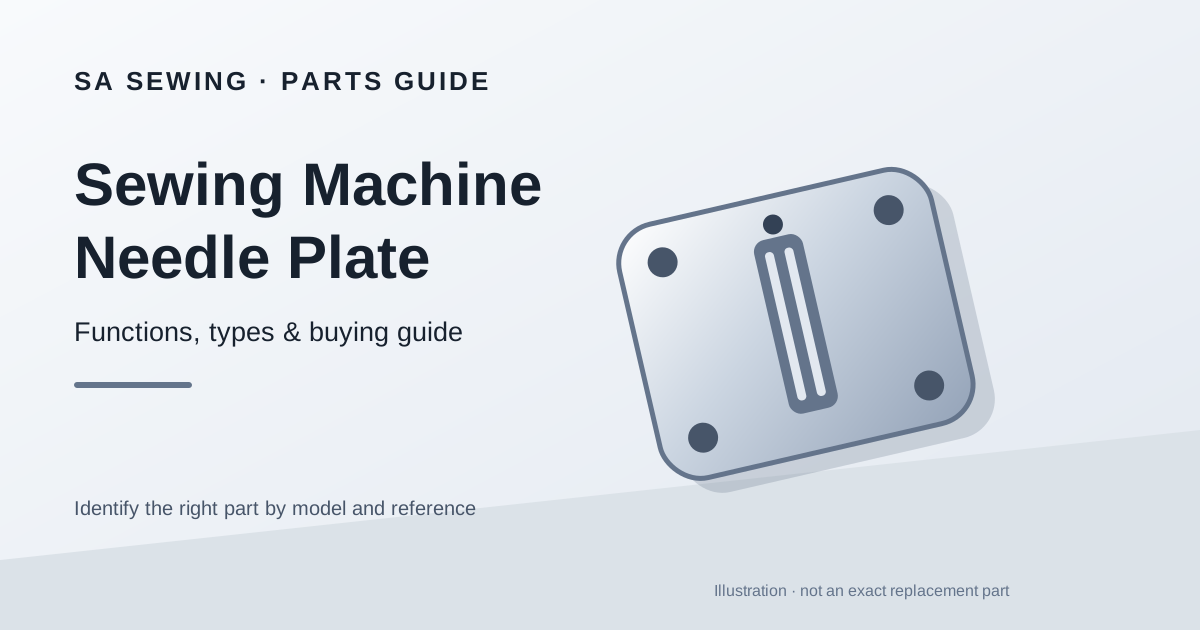
A sewing machine needle plate, also called a throat plate, is the metal plate immediately beneath the presser foot and needle. Its opening lets the needle pass into the stitch-forming area, while slots or openings allow the feed dogs to rise and move fabric through the machine.
The plate provides a smooth support surface around the needle opening. The shape and size of that opening matter: a small straight-stitch hole supports fabric close to the needle, while a wider opening accommodates lateral needle movement where the machine is designed for it. A mismatched plate can cause needle strikes, poor feeding, fabric damage or broken needles.
Common types of needle plates
Straight-stitch needle plates generally have a relatively small needle opening. They are used with compatible straight-stitch machines and setups. A plate intended for zigzag or other lateral needle movement usually has a wider opening. Never assume a plate is interchangeable merely because its outline looks similar.
Industrial overlock and serger needle plates differ from ordinary lockstitch plates. They may include stitch fingers and openings designed for loopers, knives and multiple threads. Subclass and stitch-width variations can require different plates even within the same machine family.
Specialized plates also exist for particular fabric-handling operations. Their geometry is specific to the machine and application, so a generic description such as 'industrial needle plate' is not sufficient to establish fit.
How to identify the correct replacement
Start with the complete manufacturer and machine model, including any subclass or suffix on the identification plate. Find the corresponding manufacturer's parts list and locate the needle plate or throat plate in the illustrated parts breakdown. Record the exact reference number, revision and any notes about gauge, stitch width or subclass.
Compare the removed part with the documented replacement: mounting-hole positions, plate outline, needle opening, feed-dog slots, stitch finger and any additional cut-outs. Physical similarity alone does not prove compatibility. If a supplier lists multiple equivalent references, request written confirmation and compare them against the machine documentation before ordering.
For example, a Juki MO-6714S overlock needle plate is not automatically interchangeable with a Juki DDL-8700 lockstitch needle plate. Both belong to industrial sewing machines, but their stitch-forming mechanisms are different.
Signs a needle plate needs attention
Check the plate if fabric repeatedly snags near the needle, the machine begins breaking needles, or stitches become irregular after a needle strike. Burrs around the needle hole, cracks, deep scratches, corrosion or damaged feed-dog openings can interfere with fabric movement and thread formation.
A needle plate is not always the underlying cause. Needle installation, presser-foot alignment, feed-dog timing, needle deflection and thread tension can produce similar symptoms. Disconnect power before inspecting or replacing machine parts, and have a qualified technician investigate repeated needle strikes or timing problems.
Choosing a plate for different fabrics
For fine or lightweight fabrics, the support around the needle hole can influence whether material is pushed down into the opening. A compatible small-hole straight-stitch plate may help, but it must match the machine's permitted needle motion and the selected needle size.
For heavier materials, confirm the machine's rated capability and the manufacturer's approved plate, feed-dog and needle combination. A larger opening is not automatically better. For overlock operations, verify the exact stitch width, number of threads and subclass before choosing a replacement.
Buying industrial sewing machine needle plates
When comparing suppliers, prioritize an exact manufacturer reference, a clearly stated machine model, documented compatibility and a photograph of the actual part. Ask whether the item is original manufacturer stock or an aftermarket compatible part; do not infer OEM status from the presence of a brand name in a listing.
If the part number is unreadable, take clear photographs of both sides of the removed plate, the needle opening, mounting holes and the machine's model label. These details help a parts specialist narrow down the correct reference without guessing.
Find a compatible needle plate
Browse our needle plate category, explore Juki DDL-8700 parts, or send a photo and model number so we can help identify a matching reference. You can also request a quote with your verified part number.
Technical note: Machine compatibility must be checked against the manufacturer's documentation for the exact model and subclass. This article provides general identification guidance, not an interchangeability guarantee.